
Penetration Testing After a Data Breach
CodeShield helps UK organisations recover from a security breach with CREST-accredited testing that confirms the way in is closed, uncovers anything else an attacker could reach, and gives you the evidence your regulators, insurers and customers now expect. Calm, discreet and fast when it matters most.



CREST-accredited penetration testing Services
Is a penetration test the right response to a breach?
It’s a fair question to ask when you’re under pressure, and the honest answer has some nuance to it.
A penetration test is not incident response. If an attack is still live, your first priority is to contain it: isolate affected systems, preserve evidence, reset credentials and, where needed, bring in incident response and forensics specialists. That work answers “what is happening and how do we stop it right now”.
Penetration testing answers a different, equally important set of questions, and it comes into its own once the immediate fire is out:
- Is the vulnerability the attacker used actually closed, or does the fix just look right on paper?
- Did they reach further than you first thought, and is there another way back in?
- Can you now prove, to the ICO, your insurer and your customers, that you’ve genuinely remediated and not just papered over the gap?
Put simply: incident response stops the bleeding, and post-breach penetration testing confirms the wound is closed and checks for others. Most organisations need both, in that order. We’ll tell you plainly where you are in that process and whether testing is the right next step, or whether you need something else first.










Start with the fire, not the survey
If you believe an attack is active right now, do these things before you think about testing:
- Contain it. Isolate affected systems and disable compromised accounts, without wiping evidence you may need later.
- Preserve evidence. Don’t rush to rebuild. Logs and system images matter for forensics and for any regulatory or insurance process.
- Notify the right people. UK GDPR requires you to report a qualifying personal data breach to the ICO within 72 hours of becoming aware of it. Your cyber insurer usually needs to be told early too, and often has a panel you’re required to use.
- Get incident response in. Live containment and forensic investigation are a specialist discipline in their own right.
Once you’re contained and stable, that’s when a penetration test earns its place. Not sure which stage you’re at? Call us and we’ll help you work it out, honestly, in fifteen minutes.
START HERE
Not sure which test you need?
Most people searching “pen test” aren’t sure yet, that’s normal. Pick the closest match, or talk it through directly with a tester. We can incorporate multiple testing types for a single project. We often do web app + network testing if a business wants to cover both.






WHY TRUST CODESHIELD
Trusted & Independently verified.

How testing helps you recover – What a post-breach penetration test actually does
A post-breach test isn’t a box-ticking exercise, and it isn’t a repeat of the same generic scan that may have missed the problem in the first place. It’s a focused piece of work aimed squarely at your recovery. Here’s how it helps:
- Confirms the entry point is closed. We test the specific vulnerability or misconfiguration behind the breach, where it’s known, and verify the fix holds up against a real attacker’s techniques, not just a patch note.
- Checks how far an attacker could have gone. Breaches rarely stop at the first system. We look for the lateral movement paths, weak internal controls and secondary weaknesses an attacker could have used to reach more than you realise.
- Finds the other doors left open. Where one exploitable weakness existed, others often do. We assess the wider environment so you’re not fixing one hole while three more stay open.
- Gives you evidence you can stand behind. You’ll get a clear, dated report showing what you tested, what you found and what you fixed, the kind of independent evidence the ICO, insurers and enterprise customers ask for when they want proof of remediation.
- Reduces the risk of a repeat. Organisations that have been breached once are frequently targeted again, sometimes by the same actor. Testing helps you close the gaps before they’re used a second time.
The result is a test that does double duty: it genuinely strengthens your security, and it produces the evidence your recovery depends on.

Which test do you need after a breach?
The right test depends on where the breach happened and where your exposure now sits. Most organisations need one or two of the following, and we’ll help you scope the right combination on a short call. We regularly combine testing types, for example web application plus network testing, to cover the full picture in a single engagement.
Still not certain? Tell us what happened and we’ll scope it with you on a 15-minute call.
WHY CODESHIELD – 20+ YEARS EXPERIENCE
You work with the person doing the testing.
At CodeShield, our UK penetration testing team brings 20+ years of combined expertise delivering practical, results-driven security solutions tailored to your business.
You work directly with a fully-qualified pen tester. You meet them before you pay, so you know who you’re working with.

Our Values
What’s in your penetration testing report
The report is where a post-breach test earns its value. It does two jobs at once: it tells your team exactly what to fix, and it’s the independent evidence you show to everyone now asking whether you’ve genuinely resolved the problem. Ours are built to be read and acted on, not filed away.
See a sample report
Want to see the quality of our reporting before you commit? Download an anonymised sample penetration testing report and see exactly what you’ll receive: the structure, the depth of detail, and the clarity of our remediation advice.

Types of breach – Whatever kind of incident you’ve had
We help organisations recover from, and verify the fix for, a wide range of incidents:
- Ransomware: confirming the entry route is closed and the environment is safe to trust again before you fully resume operations.
- Business email compromise and payment fraud: testing the account, email and payment-process weaknesses that let it happen.
- Web application or website compromise: finding and validating the flaw behind a defacement, data exposure or skimming attack.
- Cloud data exposure: assessing the misconfiguration or over-broad permission that left data reachable, and checking for others.
- Credential theft and account takeover: testing authentication, access controls and the blast radius of a compromised account.
- Third-party or supply-chain compromise: assessing your exposure where the weakness sat with a vendor or integration.
- Suspected but unconfirmed breach: where something looks wrong and you need an expert eye to find out whether, and how, you’re exposed.
If you’ve had an incident, or you think you might have, and you need to know it’s genuinely closed, our testing is built for you.
LIVE REPORTING
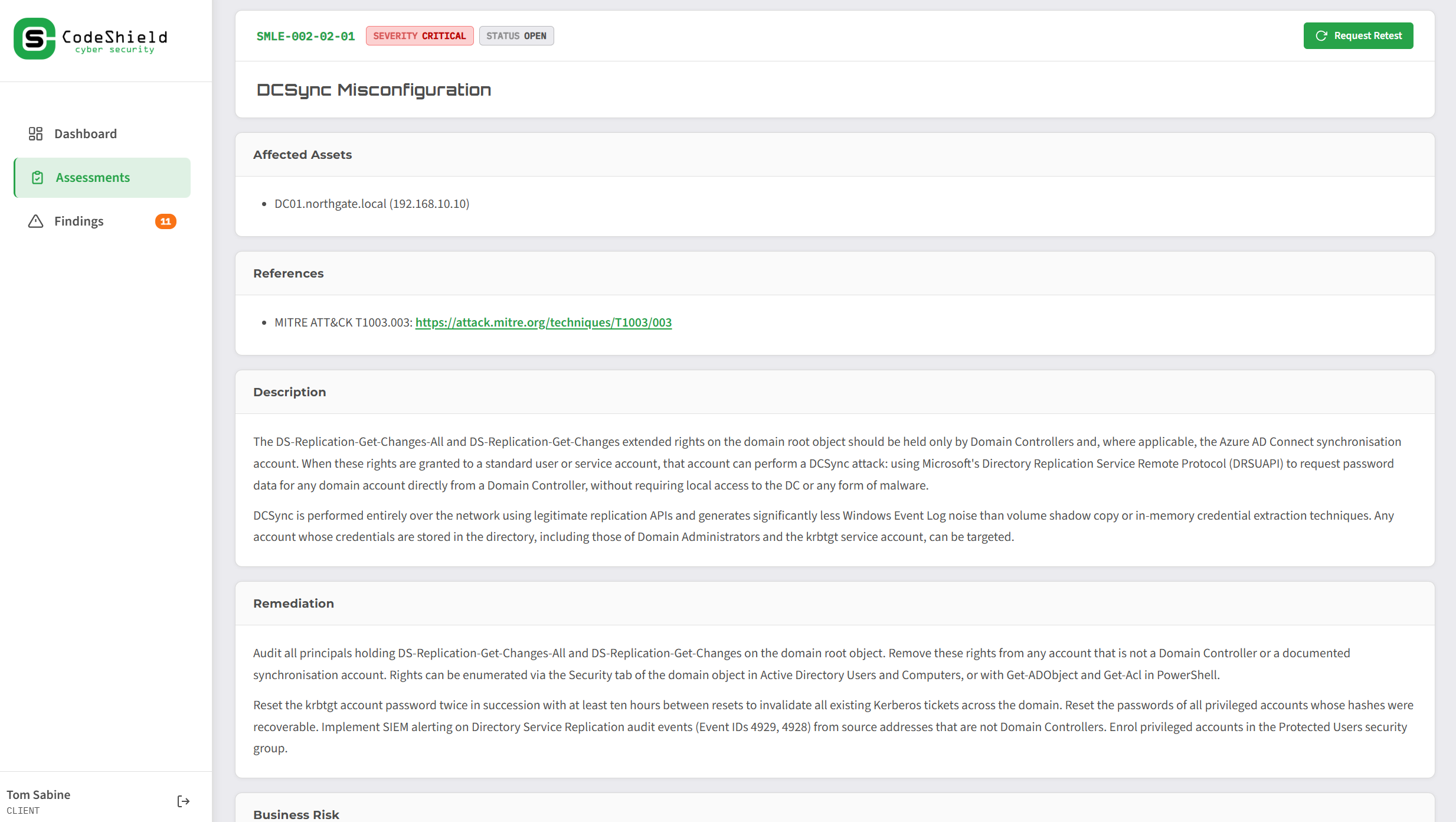
Stay informed throughout your penetration test with real-time access to findings through our secure client portal.
Stay informed throughout your penetration test with real-time access to findings through our secure client portal. This matters most after a breach, when you can’t afford to wait days to learn something is still exposed.
As vulnerabilities are identified, they’re immediately available for your team to review, giving you complete visibility as the assessment progresses. Any High or Critical findings are communicated straight away via your agreed contact channels, so urgent risks are never left waiting until the final report.
Our collaborative approach also allows for interactive re-testing during the engagement. As fixes are implemented, our consultants validate them in real time, helping you close findings and reduce outstanding risk before you sign off your recovery.
At the end of the engagement, your portal is updated with the final quality-assured report: a comprehensive, audit-ready record of the assessment, findings, remediation guidance and supporting evidence.
TRUSTED UK PENETRATION TESTERS
Had a breach? Talk to CodeShield today
At CodeShield, our UK penetration testing team brings 20+ years of combined expertise, delivering practical, results-driven security when you need it most.
Penetration testing FAQs
The cost depends on scope: the size and complexity of the application, the number of user roles and APIs, and the depth of testing required. Rather than quote a misleading flat rate, we scope every engagement individually so you only pay for testing that delivers real value. Get in touch for a tailored quote.
Yes. Our support doesn’t end at the report. Once you’ve addressed the findings, we can retest to confirm the fixes are effective, giving you and your stakeholders verified assurance that the risks have been closed.
CREST accreditation is an internationally recognised standard that demonstrates a provider’s technical expertise, testing methodology, and quality processes have been independently assessed. For many compliance frameworks and enterprise customers, CREST accredited testing is either required or strongly preferred.
Yes. Each platform has its own risks and security model, so we test both with platform-specific expertise. If your app is on one platform or both, we tailor the engagement to match.
Not necessarily. We can test with no access (black box), partial access (grey box), or full access to source code (white box). Grey and white box testing often uncover more, and we’ll help you choose the right approach during scoping.
Every engagement ends with a comprehensive report detailing the vulnerabilities we found, how they could be exploited, and their potential business impact. Each finding is prioritised by risk and paired with practical, actionable remediation advice, written to be clear for technical teams and senior stakeholders alike.
Most major providers now permit customer-authorised penetration testing of your own environment, though some activities carry specific rules. We handle this as part of scoping, ensuring all testing stays within your provider’s acceptable use policies.